

Escazú in the Caribbean: Turning Commitments into Action
By Michelle Brathwaite
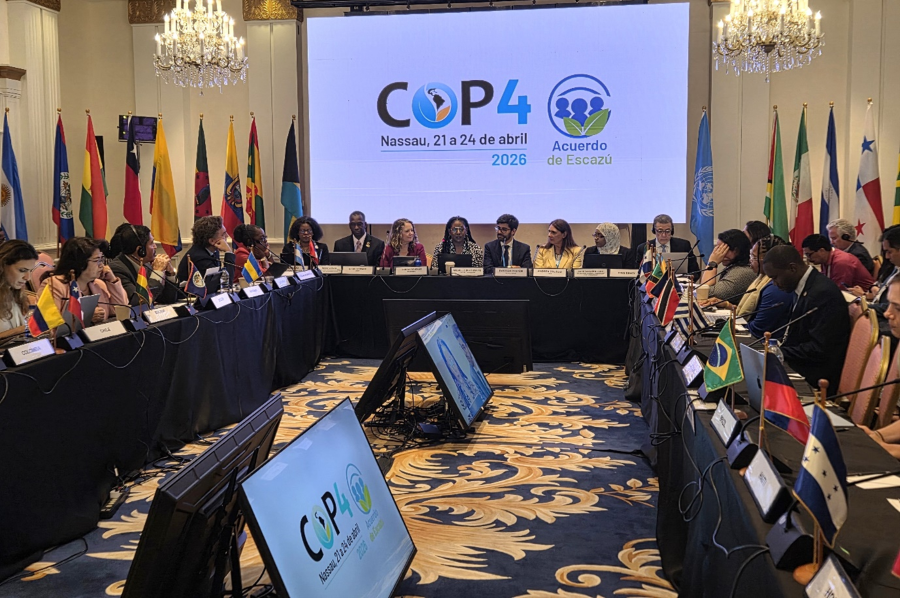
When The Bahamas hosted the Fourth Conference of the Parties (COP) to the Escazú
Agreement in April, it marked the first time the conference had been held in the Caribbean.
For a region on the front lines of climate change, biodiversity loss and intensifying
development pressures, the moment could not be more timely. The Escazú Agreement is a landmark regional treaty that guarantees the rights to access information, public participation, and justice in environmental matters. At its core, it is about how decisions are made, who has a voice, and how human rights are protected when
development and environmental protection intersect. For small island and coastal states, where ecosystems are fragile and communities depend directly on land, sea and natural resources, these principles are fundamental.
Ten of the 19 countries that have ratified the Escazú Agreement are from the Caribbean: Antigua and Barbuda, The Bahamas, Belize, Dominica, Grenada, Guyana, Saint Kitts and Nevis, Saint Lucia, Saint Vincent and the Grenadines, and Trinidad and Tobago. Their leadership reflects a growing regional commitment to transparency, participation, accountability and the protection of environmental human rights defenders. I encourage other Caribbean States to follow their example.
The urgency is clear. Climate change is intensifying storms, flooding and sealevel rise.
Biodiversity loss threatens food security and livelihoods. At the same time, development pressures continue to grow. Decisions taken today will determine whether development strengthens resilience and inclusion or deepens inequality and environmental harm.
These issues were front and centre at an official COP side event organized by the UN
Human Rights Office. Speakers representing diverse sectors of society engaged openly on the human rights obligations of States and responsibilities of businesses and one message was clear: communities affected by environmental decisions must be informed early and able to participate meaningfully.
This is not only a human rights obligation; it is also sound policy. When communities are excluded, projects often face resistance, delays and loss of trust. When participation is genuine and timely, decisions are stronger, risks are better managed, and outcomes are more sustainable over time.
But challenges remain. Greater awareness is still needed of the protections and opportunities the Agreement offers – not only for communities, but also for States and businesses.
One of the Agreement’s most important provisions is Article 9, which focuses on the
protection of environmental human rights defenders. Across the Caribbean, individuals and communities work courageously to protect ecosystems and the rights of others, often with limited resources and at personal risk. Intimidation or reprisals against those who raise environmental concerns are incompatible with international human rights law and with the commitments States have made under the Escazú Agreement.
They also undermine the principles of participation and trust that Caribbean countries reaffirmed at the COP. States in the region should ensure that individuals working to defend the environment and human rights are able to carry out this work safely and without intimidation. And businesses operating in the Caribbean must ensure that their activities do not contribute – directly or through their value chains – to threats, criminalization or reprisals against those who raise environmental concerns.
The UN Human Rights Office for the Caribbean remains committed to supporting States through capacitybuilding, and technical assistance on the rights of access to information, public participation in decisionmaking, access to justice, and the application of a human rightsbased approach to environmental action.
Hosting COP4 in The Bahamas was a powerful reminder that the Caribbean is not only
vulnerable – it is also leading. With continued cooperation and political will, the Escazú
Agreement can help ensure that development is inclusive and participatory and that it protects the right to a healthy environment for present and future generations.
Michelle Brathwaite is Regional Representative of the UN Human Rights Office for the
Caribbean Community


Comments