

Cuban Foreign Minister: The blockade, energy siege and military threat define Cuba-U.S. relations
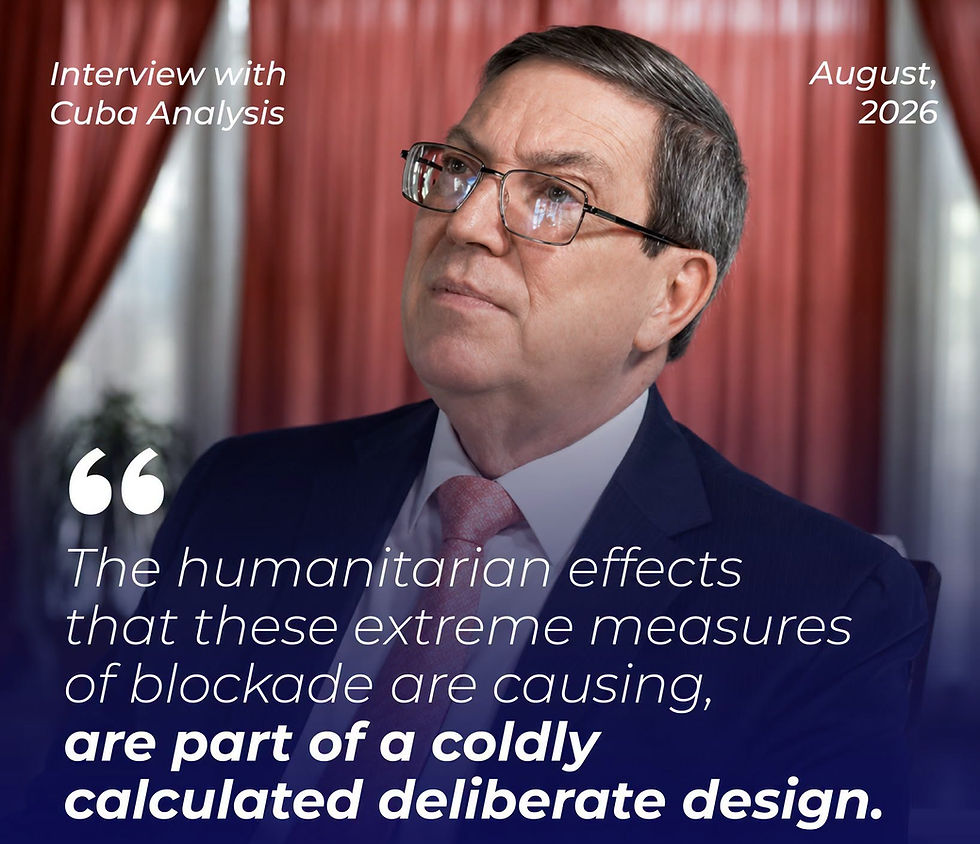
Cuba’s Minister of Foreign Affairs, Bruno Rodríguez Parrilla, gave an extensive interview to the Cuba Analysis Podcast, hosted by researchers Helen Yaffe and Nina Blodau, in which he reviewed the current state of relations between Havana and Washington and addressed the ongoing impact of the U.S. blockade, the tightening of measures since 2019 and 2026, the island’s economic and social situation, the possibility of military aggression, and the future prospects for bilateral relations.Rodríguez began by speaking from a personal perspective. He recalled that he has lived his entire life under U.S. sanctions and that several generations of Cubans have now been in this situation. Regarding the current situation, he was unequivocal:
“The suffering experienced by our people—by every Cuban—the hardships and anguish, are extreme.” In his view, the measures constitute a mechanism of collective punishment, and their impact has worsened significantly since 2019—and especially with the executive orders adopted in 2026.In response to the argument that Cuba’s economic difficulties stem primarily from its political system or internal mistakes, Rodríguez replied unequivocally: “They’re lying; they’re lying systematically.” He maintained that Washington is trying to blame the Cuban government for consequences that, according to him, are deliberately caused by sanctions and by trade, financial, and energy restrictions.One of the facts he highlighted was the existence of more than 7,000 containers of food, medicine, and medical devices stranded in various ports, a situation he attributed to threats and pressure against shipping companies that trade with Cuba. He also pointed to the rise in infant mortality as one of the most serious effects, which he directly linked to the conditions created by the blockade.For the Cuban foreign minister, the energy sector is currently one of the most critical issues. He stated that the measures adopted in 2026 have created a situation that is, in practice, equivalent to a naval blockade. “If Cuba were able to acquire even minimal amounts of fuel today, power outages could be reduced to two or three hours a day,” he said. He added that this would also significantly improve the water supply and the food situation.Rodríguez also rejected the claim that Cuba received fuel for free. “That’s completely false; it’s a lie,” he stated. He explained that the island obtained hydrocarbons through commercial channels, barter agreements, or purchases made under even more costly conditions due to the risks associated with U.S. sanctions.Regarding the international stance against the blockade, he highlighted the United Nations votes and asserted that there is widespread global opposition. According to Rodríguez, Cuba often ends up expressing positions that other countries share but do not always articulate with the same forcefulness. In that regard, he stated: “Cuba can speak with complete freedom; it can pursue a fully independent and sovereign foreign policy.”One of the most powerful moments of the interview came when he was asked about the possibility of U.S. military aggression. Rodríguez asserted that Havana does not view these statements as a mere propaganda ploy: “It is a threat that we take seriously—very seriously—and it is of the utmost gravity.”He warned that a conflict would result in the deaths of both Cubans and Americans, as well as serious destabilization in the Caribbean, the Gulf of Mexico, trade routes, and the region as a whole.Regarding Cuba’s response to such a scenario, he stated that the country is preparing to defend itself but is simultaneously working to prevent any escalation. “Our people would undoubtedly defend their independence, their sovereignty, and the territorial integrity of our homeland to the very end,” he maintained.Regarding the U.S. announcement of $100 million in humanitarian aid, Rodríguez questioned whether it would actually be delivered. He noted that previous aid packages of $3 million, $9 million, and then $6 million had been announced, but asserted that only a portion of those funds had actually arrived. As for the $100 million, he stated that so far the aid received had reached only about 700 families.Another key issue was Cuban medical cooperation. Rodríguez defended the international role of the island’s health professionals and asserted that Cuba remains a major provider of South-South medical cooperation. He also argued that the sanctions harm citizens of other countries by limiting their access to Cuban technologies and medications, including treatments for cancer, diabetes, diabetic foot, and neurodegenerative diseases.Toward the end of the interview, he insisted that decades of U.S. policy have failed to change the Cuban political system.
He reiterated the argument that, after so many years of a policy that has failed to achieve its stated objectives, Washington should reconsider it. “No matter how extreme its measures may be, it’s not going to work,” he asserted.Rodríguez pointed to previous periods of bilateral rapprochement as proof that a different kind of relationship is possible. He said those periods demonstrated that both governments can engage in dialogue, negotiate, and resolve specific problems. He also reiterated Cuba’s willingness to engage in dialogue “on the basis of international law, sovereign equality, on an equal footing, mutual respect, and mutual benefit,” without interference in internal affairs or preconditions.His conclusion was openly optimistic:
“In the end, a civilized, productive, and respectful relationship between our two peoples will prevail.” For the foreign minister, that normalization may come about under the current U.S. administration or a future one, but he considers it inevitable that a relationship based on dialogue, trade, and cooperation will ultimately prevail.The full interview can be viewed at the following link: https://youtu.be/LqlQhqvNnqM?si=cJFxrtsCOl0ZP3Zx


Comments